


.avif)
SPIN Selling has long been one of the most respected consultative sales frameworks. The logic behind Situation, Problem, Implication, and Need-Payoff questions is still sound, and buyers still respond well to thoughtful discovery.
What has changed is the selling environment. Buyers arrive informed, sales cycles are less predictable, and reps manage far more conversations than ever before. Managers, meanwhile, don’t have the time or visibility to coach every call in detail.
This gap between knowing SPIN and executing it consistently is where AI SPIN selling emerges. AI doesn’t replace the methodology. It brings SPIN to life in day-to-day selling by embedding coaching directly into real conversations.
What Is AI SPIN Selling?
AI SPIN selling is the use of artificial intelligence to reinforce, guide, and coach SPIN behaviors throughout the sales process. Instead of relying on training sessions or manuals, AI continuously observes sales interactions and helps reps apply the right type of question at the right moment.
In practice, this means SPIN becomes less of a framework reps try to remember and more of a system that supports them automatically. AI highlights missed opportunities, strengthens weak discovery, and ensures that SPIN principles are applied consistently across the team.
Why Traditional SPIN Coaching Breaks Down
Most sales organizations still approach SPIN as a one-time learning event. Reps are trained, certified, and then expected to execute perfectly in live calls. Over time, pressure to close deals pushes them back toward pitching and feature-led conversations.
Coaching also becomes subjective. Managers review only a small percentage of calls, rely on memory, and provide feedback long after the moment has passed. As a result, SPIN is understood intellectually but rarely practiced with discipline.
AI changes this dynamic by making coaching continuous, objective, and scalable.
How AI Re-Imagines Each Stage of SPIN Selling
AI does not change the logic of SPIN Selling. It changes how reliably each stage is executed in real conversations. Below, each stage is re-imagined through AI-driven coaching, using clear structure without turning the methodology into a rigid script.
1. Situation: Reducing Noise, Increasing Relevance
In traditional SPIN selling, situation questions often turn into long interrogations. Buyers are asked questions that could have been answered through basic research, creating friction early in the call.
AI improves this stage by:
- Analyzing CRM data, past interactions, and buyer signals before the call
- Identifying knowledge gaps that truly matter
- Helping reps avoid obvious or redundant questions
The result is sharper context‑setting, fewer unnecessary questions, and a more credible first impression.
2. Problem: Moving Beyond Surface‑Level Pain
Many reps identify problems but stop too early. They acknowledge a challenge without exploring root causes or operational impact.
AI strengthens this stage by:
- Detecting vague or incomplete problem statements
- Flagging missed follow‑up opportunities
- Encouraging deeper diagnostic questioning
Over time, reps build a habit of thorough discovery instead of rushed agreement.
3. Implication: Creating Real Urgency
Implication questions are the most powerful and most skipped part of SPIN. Without implications, problems remain theoretical and urgency never forms.
AI reinforces implication questioning by:
- Identifying when problems are discussed without consequences
- Prompting exploration of financial, operational, or strategic impact
- Making urgency a repeatable behavior, not a top‑performer skill
This helps deals move forward with clearer stakes and fewer stalls.
4. Need‑Payoff: Letting the Buyer Articulate Value
SPIN is most effective when buyers define value in their own words rather than being told what matters.
AI supports this stage by:
- Connecting earlier implications to desired outcomes
- Nudging reps away from premature pitching
- Keeping conversations focused on buyer‑defined success
This strengthens alignment, internal buy‑in, and deal confidence.
Why Sales Teams Are Adopting AI SPIN Selling
SPIN selling hasn’t stopped working but the conditions required to execute it well have changed. As sales teams operate across distributed setups, face more informed buyers, and carry tighter quota pressure, consistent SPIN execution has become harder to sustain. AI SPIN selling is being adopted to solve this execution challenge, giving teams the structure, visibility, and coaching needed to apply SPIN effectively at scale.
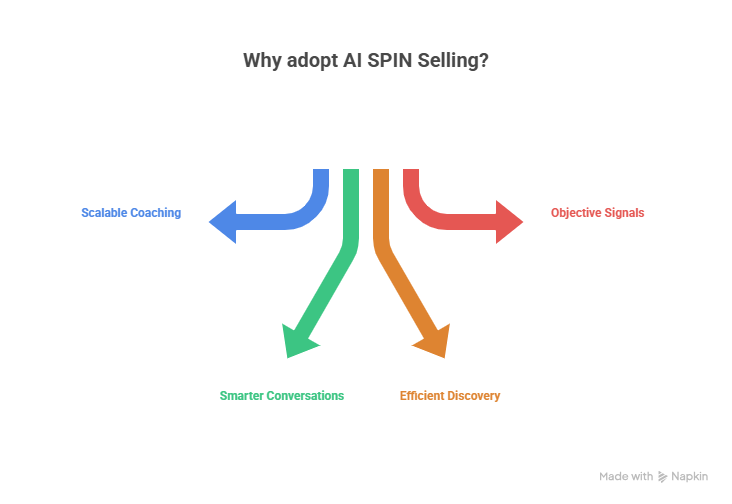
1. Distributed Teams Need Scalable Coaching
With remote and hybrid selling, managers can no longer rely on ride-alongs or ad hoc call reviews. AI enables consistent coaching regardless of geography, ensuring every rep receives guidance aligned with SPIN principles.
2. Buyers Expect Smarter Conversations
Today’s buyers are well-researched and time-conscious. AI helps reps avoid basic discovery mistakes and ask sharper questions, improving buyer experience without increasing call length.
3. Quota Pressure Leaves No Room for Weak Discovery
Missed implication or need-payoff questions directly impact deal velocity. AI SPIN selling helps teams identify these gaps early, reducing stalled deals and late-stage surprises.
4. Managers Need Objective Coaching Signals
Instead of relying on intuition, managers gain clear visibility into which SPIN behaviors correlate with wins and losses. Coaching becomes data-driven rather than opinion-based.
Best Practices for Implementing AI SPIN Selling
While AI automates much of the coaching process, success still depends on how teams use the insights.
- Focus on improving questioning behaviors, not enforcing scripts.
- Connect SPIN improvements to deal outcomes and pipeline movement.
- Use AI insights as the foundation for regular one-on-one coaching.
- Treat SPIN as an ongoing practice, not a completed training.
Where Pepsales Fits In
Pepsales AI approaches AI SPIN selling as an AI-first coaching system designed to turn methodology into consistent execution.
How Pepsales Supports AI SPIN Selling
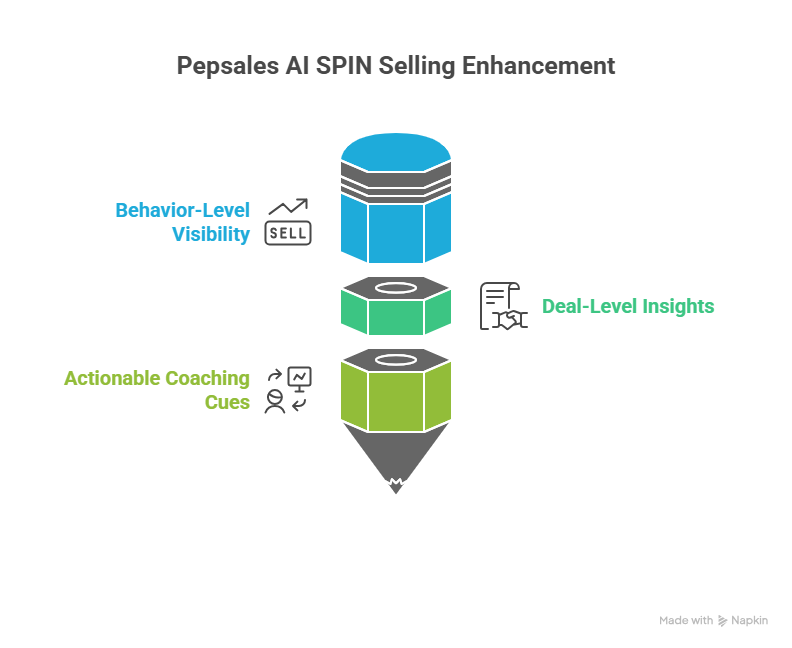
- Behavior-level visibility: Pepsales shows how SPIN questions actually appear in live sales conversations.
- Deal-level insights: It highlights where deals lose momentum due to weak discovery or missing implications.
- Actionable coaching cues: Managers receive clear guidance on what to coach, not just what happened.
Rather than functioning as a passive analytics dashboard, Pepsales AI acts as a coaching layer that reinforces SPIN behaviors continuously across the pipeline.
Final Thoughts
SPIN Selling remains relevant because buyers still value thoughtful discovery. What has changed is the need for constant reinforcement and coaching.
AI SPIN selling modernizes a proven framework by embedding coaching into everyday sales activity. For sales leaders, the challenge is no longer whether SPIN works, but whether their teams are supported well enough to apply it consistently.
AI-first coaching makes that consistency possible.
Want to see how SPIN actually shows up in your sales conversations?
Discover how Pepsales AI surfaces SPIN findings and turns them into clear coaching actions.


.avif)
.avif)
