


AI has transformed outbound sales forever but with transformation comes a critical question every founder, CRO, and GTM leader keeps asking:
“How do we measure the ROI of AI-driven outreach?”
It is no longer enough to simply adopt AI tools. Leadership wants proof. They want to see revenue gains, efficiency benefits, and clear pipeline impact that can be directly attributed to AI. Measuring AI Outreach ROI is the only scalable way to validate whether your automation actually lifts conversions, meetings, and pipeline outcomes.
This blog breaks down a clear AI Outreach ROI Framework that helps you track revenue lift using measurable signals, value indicators, and validated benchmarks.
Before diving into the framework, let’s add the most important context: how to set the right foundation.
1. Establish Your Baseline (Your “Before AI” Stage)
To measure improvement, you must first clearly define where you started. Many teams miss this critical step, and as a result, their ROI reports become unreliable. Baseline documentation ensures that any improvement after AI adoption is measurable and credible.
Your baseline should include:
- Average response rate to outbound messages
- Meeting-booked rate
- SQL conversion rate
- Win rate
- Average deal value
- Daily outreach activity
- Pipeline generated per rep
- Sales cycle length
Think of this as your “control version.” AI results will be compared against this to quantify revenue lift.
2. Identify the AI Touchpoints That Influence Revenue
AI affects revenue across the entire sales funnel not just during outreach. Understanding where AI impacts your GTM motion helps you measure improvements more accurately.
AI impacts revenue through four core touchpoints:
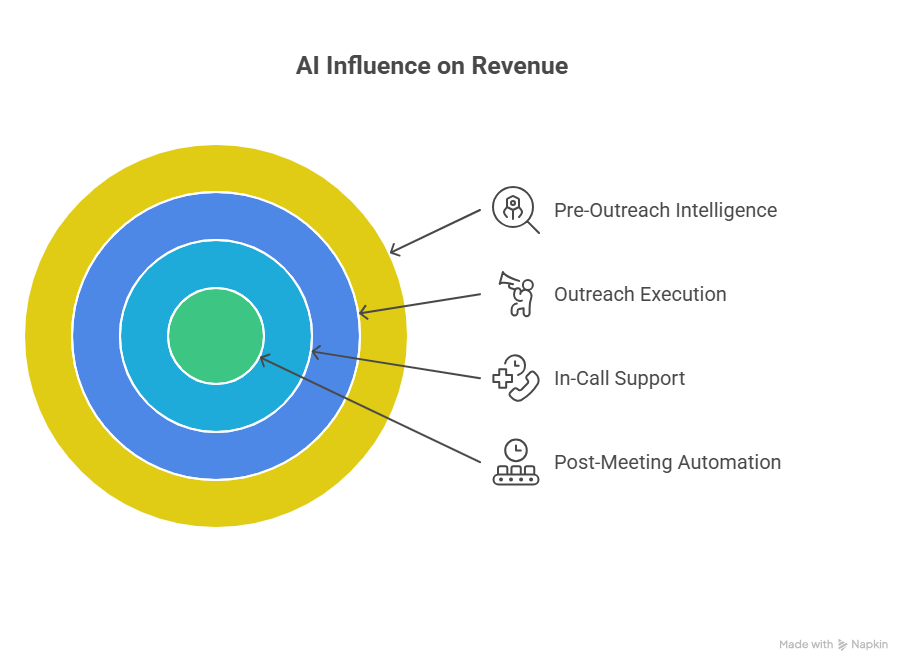
a) Pre-Outreach Intelligence
AI identifies high-intent prospects, improves ICP matching, and ranks leads based on conversion likelihood. This ensures reps spend more time on prospects who can actually convert.
b) Outreach Execution
AI-generated personalization, optimized sequences, and timely follow-ups dramatically improve engagement. This directly impacts response rates and meetings booked.
c) In-Call Support and Real-time Assistance
AI captures notes, identifies objections, creates action items, and provides summaries. This enhances call quality and ensures faster follow-ups and better alignment.
d) Post-Meeting Automation
AI sends recaps, updates CRM, triggers reminders, and supports deal progress. This keeps momentum strong and reduces pipeline slippage.
When all these touchpoints work together, they create measurable, compounding revenue impact.
3. The AI Outreach ROI SV Framework (Signal → Value)
This framework is the core of ROI measurement. It simplifies a complex process into two measurable layers.
S = Signal (Performance Improvement Indicators)
Signals show whether AI is helping your sales motion become more effective. These are observable behaviors and outcomes, that occur before revenue shows up but lead to higher revenue.
Key Signals include:
- Higher reply rates
- More meetings booked
- Faster follow-ups
- Complete and accurate CRM updates
- Better call summaries
- Higher buyer engagement
- Shorter time between touchpoints
Signals help you understand whether AI is improving your process. But to measure revenue lift, you need to move from signal → value.
V = Value (Actual Business & Revenue Outcomes)
Value refers to the direct financial impact created by those signals. These are measurable, revenue-related outcomes.
Key Values include:
- Revenue from AI-booked meetings
- Revenue from AI-nurtured deals
- Improved win rates
- Reduced sales cycle length
- More pipeline generated per rep
- Time saved → additional selling hours
- More deals moving to later stages
AI Outreach ROI = (Signal Improvements × Financial Value)
This removes guesswork and turns AI impact into measurable numbers.
4. How to Measure Actual Revenue Lift (4 Key Metrics)
Here are the four core revenue indicators every team should track after implementing AI outreach.
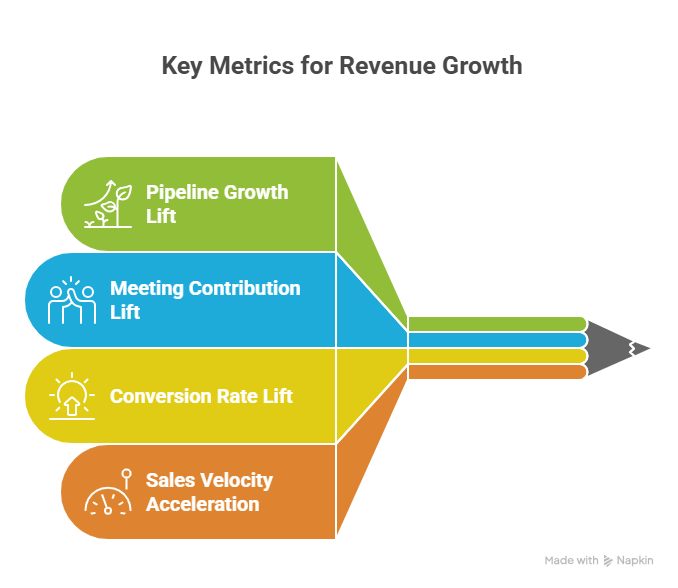
1. Pipeline Growth Lift
Pipeline created after AI minus pipeline before AI.
This shows whether AI creates more qualified opportunities.
2. Meeting Contribution Lift
Measure how many meetings were booked directly or indirectly through AI.
Meetings are the strongest revenue predictors.
3. Conversion Rate Lift
Compare conversion rates before and after AI adoption.
Even a 5–10% lift can translate into massive revenue increases.
4. Sales Velocity Acceleration
Sales velocity combines opportunities, deal size, win rate, and cycle length.
AI improves all four, accelerating revenue generation.
By tracking these metrics together, you get a full picture of revenue lift.
5. Connect Productivity Gains to Revenue Expansion
AI Outreach ROI is not only created by more bookings or better conversions. Some of the strongest ROI comes from time savings.
AI eliminates:
- Manual note-taking
- CRM updating
- Meeting recaps
- Cadence follow-ups
- Reminder management
When reps save 2–3 hours per day, this time converts into:
- More outreach
- More meetings
- More pipeline
- More closed deals
Productivity → more actions → more revenue.
6. Attribution: Proving That AI Drove the Results
A major challenge in any AI Outreach ROI narrative is proving that revenue was influenced by AI and not other external factors.
Use attribution models such as:
- First-touch attribution (AI initiated the contact)
- Multi-touch attribution (AI + rep contribution)
- Influence attribution (AI supported deal movement)
This gives a transparent view of AI’s involvement across the revenue cycle.
7. Build an AI Outreach ROI Dashboard
To maintain transparency and leadership visibility, create an ROI dashboard that includes:
- AI vs. non-AI meeting contribution
- Pipeline influenced by AI
- Conversion improvements
- Sales cycle changes
- Hours saved
- Email reply rates
- Stage progression speed
A dashboard helps CROs and founders view ROI instantly without manual calculations.
8. Benchmark Your ROI Against Industry Standards
Once AI has run for 30–60 days, compare your improvements with common industry patterns:
- Better reply and response quality
- More consistent meetings booked
- Stronger and healthier pipeline creation
- Noticeable improvement in conversion outcomes
- Smoother, faster sales cycles
Benchmarks help validate whether your AI implementation is performing above or below industry norms.
Pepsales AI: The Intelligent Outreach System Behind This ROI Framework
Pepsales AI is designed precisely for GTM teams who want accurate, measurable, and scalable AI-driven revenue results. Unlike traditional sales automation tools, Pepsales AI combines outreach intelligence, personalization, in-call assistance, and post-meeting automation all in one system.
Pepsales AI supports this ROI framework by:
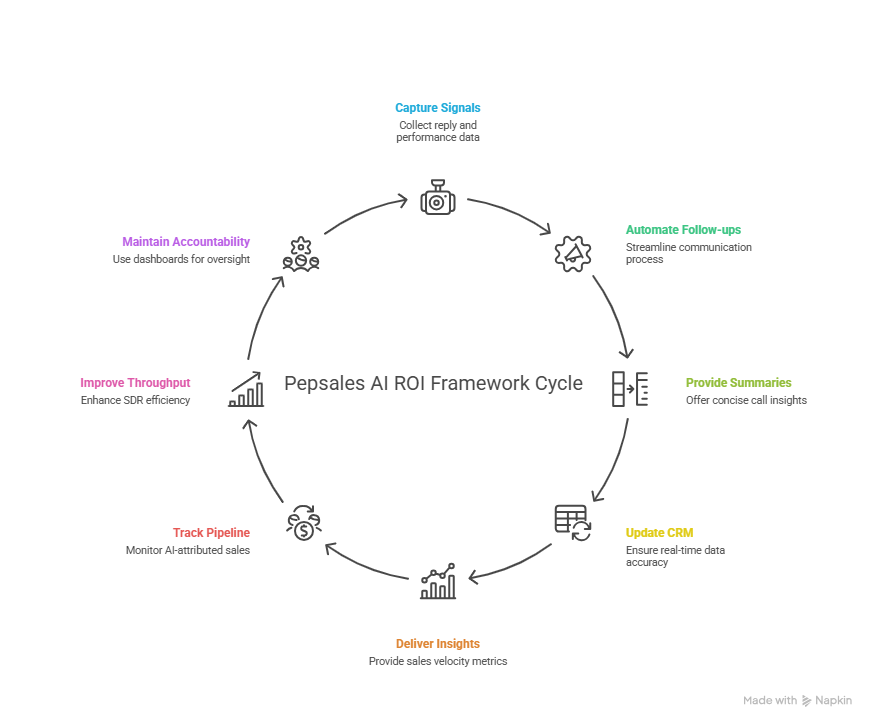
With Pepsales AI, every outreach action becomes measurable, attributable, and repeatable allowing your revenue team to scale with confidence.
Conclusion: AI Outreach ROI Is Now a Revenue Science
Measuring AI Outreach ROI is no longer about vague assumptions or gut feeling. With the right framework baseline tracking, signal-value measurement, financial attribution, and performance benchmarks revenue lift becomes visible and controllable.
AI isn’t just improving productivity; it’s rewriting the economics of sales. And with tools like Pepsales AI, teams can finally prove the ROI of every touchpoint, from the first outreach to the final closed deal.
Pepsales AI helps you increase meetings, accelerate pipeline, and prove clear revenue lift all backed by real data.
👉 Book a demo today and see your AI Outreach ROI in real numbers.


.avif)
.avif)
